Retained Products of Conception (RPOC): Imaging Types, Doppler Vascularity Grading, and Diagnosis
8 min readDr Sakthi G
Retained Products of Conception (RPOC): Imaging Types, Doppler Vascularity Grading, and Diagnosis
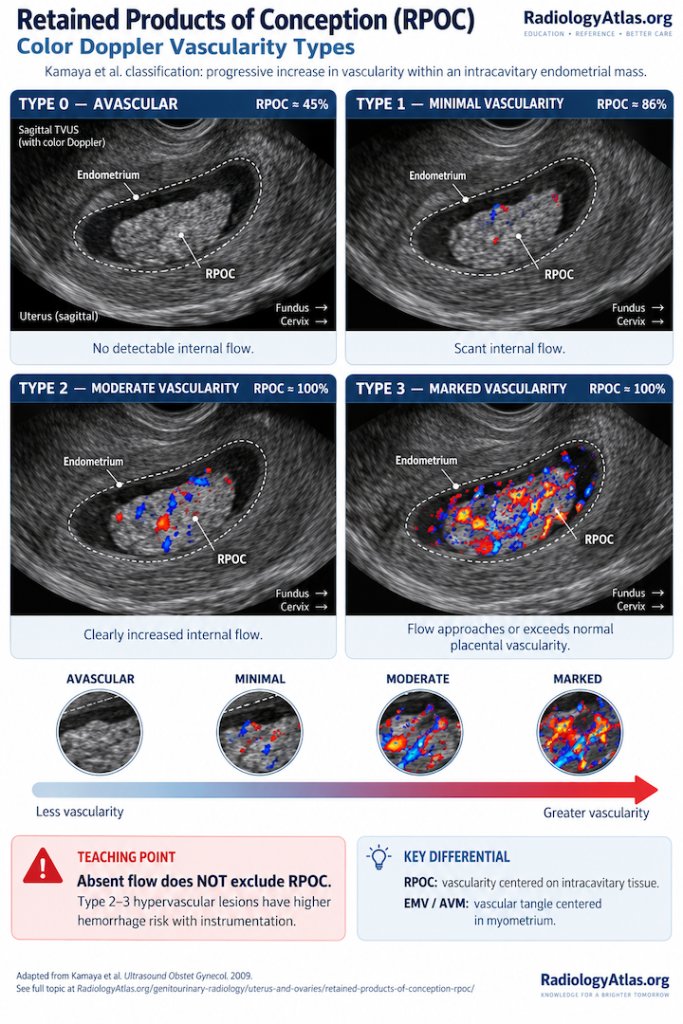
Retained products of conception (RPOC) are persistent placental or trophoblastic tissue within the uterine cavity after delivery, miscarriage, or termination, with the pathologic hallmark being chorionic villi. On imaging, the most reliable finding is an echogenic intracavitary mass or thickened endometrial complex, and color Doppler stratifies the lesion into a spectrum of vascularity. The most widely used classification is the Kamaya system, which grades RPOC vascularity into four types (type 0 avascular through type 3 markedly vascular); increasing vascularity raises the positive predictive value for RPOC but also the risk of hemorrhage at instrumentation.
Quick Reference
Definition: Persistent trophoblastic/placental tissue after any pregnancy event; histologic diagnosis = chorionic villi.
Best single US sign: Echogenic or heterogeneous intracavitary mass — most sensitive and specific gray-scale feature.
Endometrial thickness: Commonly cited cutoffs 10–15 mm; ≥15 mm most frequently used, but thickness alone is nonspecific — combine with a mass and Doppler.
MRI: Intracavitary soft-tissue mass with variable enhancement, junctional-zone disruption, and myometrial thinning.
So what: High vascularity (type 2–3 / EMV) flags bleeding risk — may steer management from routine D&C toward embolization or expectant follow-up.
RPOC color Doppler vascularity classification: Type 0 avascular, Type 1 minimal vascularity, Type 2 moderate vascularity, and Type 3 marked vascularity.
Background and Definition
Retained products of conception refers to the persistence of placental and/or trophoblastic tissue within the uterus following any completed or interrupted pregnancy — vaginal delivery, cesarean section, spontaneous or induced abortion, or elective termination. It is a common cause of secondary postpartum and post-abortal hemorrhage and can also present with persistent vaginal bleeding, endometritis, or an abnormal serum beta-hCG trend. The definitive diagnosis is histopathologic and rests on the identification of chorionic villi in the curetted or expelled tissue.
Clinically, RPOC matters because it is both common and treatable, but the imaging appearance overlaps with several entities — normal post-pregnancy debris and clot, enhanced myometrial vascularity, uterine arteriovenous malformation, and gestational trophoblastic disease. There is no single universally accepted ultrasound criterion, so the radiologist integrates gray-scale morphology, Doppler vascularity, and the clinical context rather than relying on any one measurement.
Imaging Anatomy: What You Are Evaluating
The target structures are the endometrial cavity and the adjacent junctional zone/inner myometrium. A radiologist should localize any abnormal tissue relative to three planes:
Endometrial cavity / echo complex — where RPOC tissue typically resides as a mass or thickened, heterogeneous complex.
Endometrial–myometrial interface (junctional zone) — invasive or adherent tissue disrupts this interface; on MRI, breaking of the low-signal junctional zone in contact with the remnant is a key sign.
Inner myometrium — the site of enhanced myometrial vascularity, where feeding vessels and low-resistance flow accumulate around involuting or persistent placental implantation.
Distinguishing an endometrial (intracavitary) location from a predominantly myometrial vascular focus is central: intracavitary echogenic tissue favors RPOC, whereas a purely myometrial tangle of vessels favors enhanced myometrial vascularity or AVM.
Ultrasound: Core Imaging Findings
Transvaginal ultrasound with color and spectral Doppler is the first-line and most important modality.
Gray-scale findings
Echogenic intracavitary mass — the single most sensitive and specific gray-scale finding for RPOC.
Thickened, heterogeneous endometrial echo complex — supportive but nonspecific in isolation; commonly measured, with cutoffs in the literature ranging from about 8 mm to 15 mm and ≥15 mm being the most frequently applied threshold.
Intracavitary fluid, clot, or calcification — may coexist; an avascular echogenic focus is more likely clot than viable RPOC.
Endometrial thickness alone has limited diagnostic value; the most predictive combination is a heterogeneous endometrial mass with internal vascularity on Doppler.
Color and power Doppler: the RPOC vascularity spectrum
Detecting flow within the intracavitary tissue substantially increases the positive predictive value for RPOC. Focal increased vascularity, with or without a discrete mass, is the best predictor of RPOC and is reported to be roughly 94% sensitive. The degree of vascularity varies widely, which led to the widely cited Kamaya four-tier classification:
Type
Color Doppler appearance
Approx. probability of RPOC
Type 0
Avascular — no detectable internal flow
~45%
Type 1
Minimal vascularity
~86%
Type 2
Moderate vascularity
~100%
Type 3
Marked vascularity, approaching or exceeding normal placental flow
~100%
A key teaching point: the absence of vascularity does not exclude RPOC. Type 0 (avascular) lesions still harbor RPOC in a substantial minority of cases, because devascularized or necrotic retained tissue and organizing clot can look identical. Conversely, type 2–3 hypervascular lesions are almost always RPOC and carry a higher risk of brisk bleeding during dilation and curettage — a finding worth flagging in the report.
Spectral Doppler
Vessels within or feeding RPOC typically show high-velocity, low-resistance flow. Reported peak systolic velocities range from roughly 10 to 108 cm/s (mean ~36 cm/s) and resistive indices from about 0.33 to 0.7 (mean ~0.5). Very high peak systolic velocities should raise concern for enhanced myometrial vascularity or a true arteriovenous malformation rather than simple RPOC.
MRI Findings
MRI (or contrast-enhanced CT) is reserved for equivocal ultrasound, suspected myometrial invasion, or planning intervention. The characteristic appearance is an intracavitary soft-tissue mass with variable amounts of enhancing tissue. Three principal MRI features are described:
An intracavitary remnant/mass.
Disruption (breaking) of the junctional zone in contact with the remnant.
Vascularization / flow voids infiltrating into the adjacent myometrium, with variable degrees of myometrial thinning and obliteration of the junctional zone.
The degree and pattern of enhancement, plus the extent of junctional-zone and myometrial involvement, help distinguish simple intracavitary RPOC from the hypervascular, myometrium-infiltrating variant that overlaps with enhanced myometrial vascularity and placental polyp/pseudoaneurysm.
Differential Diagnosis and Pitfalls
Enhanced myometrial vascularity (EMV) / uterine AVM: A tangle of high-velocity, low-resistance vessels centered in the myometrium rather than the cavity. EMV is a dynamic post-pregnancy finding that often involutes once associated RPOC is expelled; a myometrial (not endometrial) location and very high peak systolic velocity favor EMV/AVM. This distinction changes management — hypervascular lesions may warrant embolization or expectant serial ultrasound rather than blind curettage.
Blood clot / normal post-pregnancy debris: Echogenic but avascular; overlaps with type 0 RPOC, so short-interval follow-up or correlation with hCG may be needed.
Gestational trophoblastic disease: Can be markedly vascular and echogenic; rising or plateauing hCG and a suggestive clinical history should prompt consideration.
Endometritis: Clinical and imaging overlap; look for gas, fluid, and the clinical picture.
Clinical Impact and Reporting
The report should state whether a discrete intracavitary mass or thickened heterogeneous echo complex is present, give the endometrial thickness, and characterize vascularity using a descriptive grade (avascular vs. minimal/moderate/marked, i.e., Kamaya type 0–3) plus peak systolic velocity when a focal vessel is interrogated. Because marked vascularity signals both a high likelihood of RPOC and elevated bleeding risk, explicitly flagging type 2–3 vascularity or a possible EMV/AVM helps the gynecologist choose between curettage, uterine artery embolization, and expectant management.
Frequently Asked Questions
What are retained products of conception (RPOC)?
RPOC are placental or trophoblastic tissue that persists inside the uterus after a delivery, miscarriage, or termination. The pathologic diagnosis is confirmed by finding chorionic villi in the tissue, and patients often present with prolonged bleeding or an abnormal hCG trend.
What is the most reliable ultrasound sign of RPOC?
An echogenic or heterogeneous mass within the endometrial cavity is the most sensitive and specific gray-scale finding. Adding color Doppler and demonstrating focal internal vascularity — roughly 94% sensitive — further increases the positive predictive value.
What are the types of RPOC vascularity on color Doppler?
The Kamaya classification grades vascularity into four types: type 0 (avascular), type 1 (minimal), type 2 (moderate), and type 3 (marked). Types 2 and 3 are associated with essentially 100% probability of RPOC, type 1 about 86%, and even avascular type 0 lesions represent RPOC in roughly 45% of cases.
Can RPOC be present if there is no blood flow on Doppler?
Yes. Avascular (type 0) lesions can still be RPOC in a substantial minority of cases, because necrotic or devascularized retained tissue and organizing clot can look identical. Absent vascularity lowers but does not exclude the diagnosis, so correlation with hCG and short-interval follow-up may be needed.
What endometrial thickness suggests RPOC?
Reported thresholds range from about 8 mm to 15 mm, with ≥15 mm being the most frequently used cutoff. However, endometrial thickness alone is nonspecific; it is most useful when combined with a heterogeneous intracavitary mass and internal Doppler vascularity.
How is RPOC distinguished from enhanced myometrial vascularity (EMV) or an AVM?
Location and flow help: RPOC vascularity is centered on intracavitary tissue, whereas EMV/AVM is a myometrial tangle of vessels with very high peak systolic velocity. EMV often regresses once associated RPOC is removed. The distinction matters because hypervascular myometrial lesions may be managed with embolization or expectant follow-up rather than curettage.
References
Kamaya A, Petrovitch I, Chen B, Frederick CE, Jeffrey RB Jr. Retained products of conception: spectrum of color Doppler findings. J Ultrasound Med. 2009;28(8):1031–1041. PMID: 19643786
Sellmyer MA, Desser TS, Maturen KE, Jeffrey RB Jr, Kamaya A. Physiologic, histologic, and imaging features of retained products of conception. RadioGraphics. 2013;33(3):781–796. doi:10.1148/rg.333125177
Noonan JB, Coakley FV, Qayyum A, Yeh BM, Wu L, Chen LM. MR imaging of retained products of conception. AJR Am J Roentgenol. 2003;181(2):435–439. PMID: 12876023
Variable color Doppler sonographic appearances of retained products of conception: radiologic-pathologic correlation. Abdom Radiol (NY). 2015. PMID: 25862548
Durfee SM, Frates MC, Luong A, Benson CB. The sonographic and color Doppler features of retained products of conception. J Ultrasound Med. 2005;24(9):1181–1186. PMID: 16123177
Hamel CC, Coppus SFPJ, van Vliet HAAM, et al. Diagnostic criteria for retained products of conception — a scoping review. Acta Obstet Gynecol Scand. 2021. PMID: 34244998
Ultrasound assessment of retained products of conception (RPOC): insights from the current literature. J Clin Med. 2025. PMID: 40869690
Ultrasonographic technique to differentiate enhanced myometrial vascularity/arteriovenous malformation from retained products of conception. 2021. PMID: 33651329
This article is intended for medical education and radiology reference. It is not a substitute for individualized clinical judgment or institutional protocols.

 Dr Sakthi G