
Ovarian-Adnexal Reporting and Data System Ultrasound – O-RADS US
 sakthi379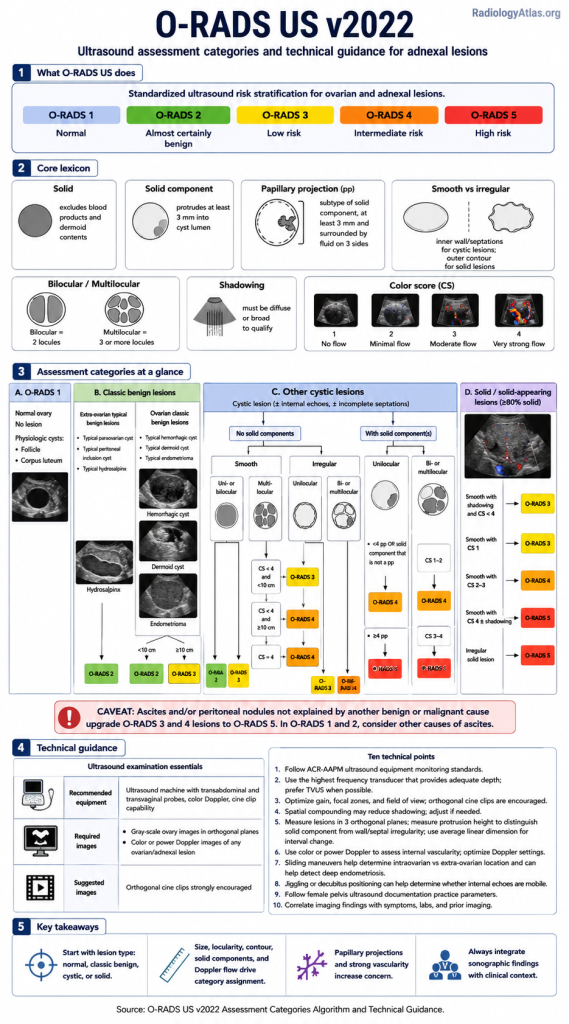
What is the O-RADS Ultrasound scoring system?
O-RADS US (Ovarian-Adnexal Reporting and Data System — Ultrasound) is a 5-category risk stratification system developed by the American College of Radiology (ACR) to standardize the reporting of ovarian and adnexal lesions on ultrasound. It assigns each lesion a score from 1 to 5 based on morphological features and malignancy risk.
What do O-RADS US scores 1 through 5 mean?
- O-RADS 1 — Normal ovaries, no lesion present. Malignancy risk: 0%.
- O-RADS 2 — Almost certainly benign lesion. Malignancy risk: < 1%. Examples include simple cysts and classic dermoids.
- O-RADS 3 — Low risk of malignancy: 1–10%. Lesions not meeting benign criteria but lacking high-risk features.
- O-RADS 4 — Intermediate risk: 10–50%. Irregular solid components or concerning vascularity.
- O-RADS 5 — High risk: > 50%. Strong morphological or vascular features suspicious for malignancy.
What ultrasound features determine the O-RADS score?
The score is based on:
- Lesion composition — unilocular cyst, multilocular, or solid
- Wall and septal irregularity — smooth vs. papillary projections
- Solid component characteristics — size and echogenicity
- Color Doppler vascularity (CS 1–4) — from no flow to markedly increased
- Associated findings — ascites, peritoneal nodules
How is O-RADS US different from IOTA or RMI?
| System | Basis | Output |
|---|---|---|
| O-RADS US | ACR morphology + vascularity | Risk category 1–5 |
| IOTA Simple Rules | 10 morphological features | Benign / Malignant / Inconclusive |
| RMI | CA-125 + USS + menopausal status | Numerical score |
References